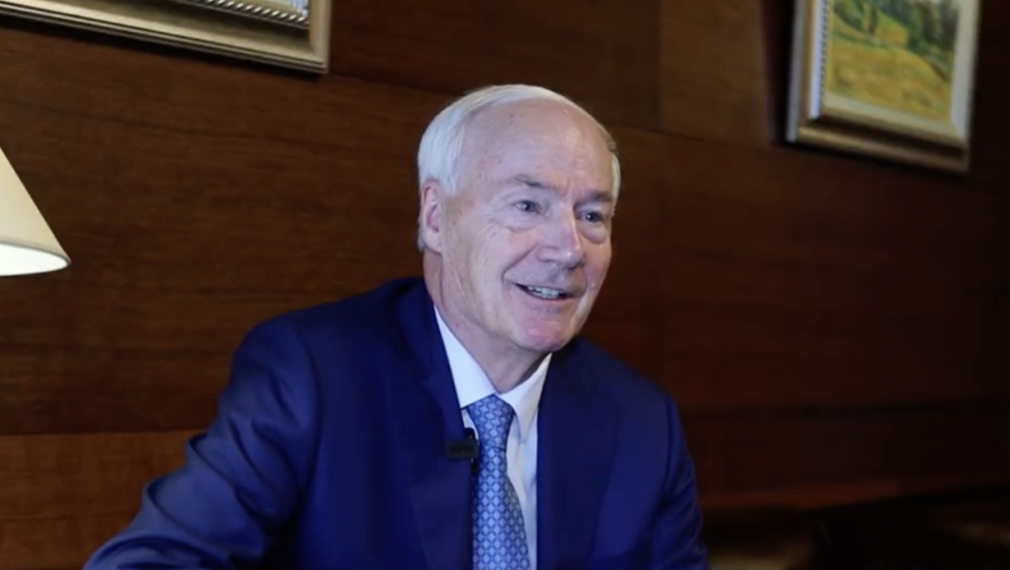
Asa Hutchinson
Asa Hutchinson is an American lawyer, businessman, and politician from the Republican Party. He was the 46th Governor of Arkansas (2015-2023), United States Attorney, Congressman, and held two key positions in the George W. Bush administration – director of the DEA (2001) and Deputy Secretary of Homeland Security (2003). In 2024, he is a candidate for the Republican presidential nomination. During his second visit to Bulgaria, Asa Hutchinson emphasized that the energy transition from coal to cleaner sources is a strategic opportunity for the country. He expressed readiness for American companies to support Hristo Kovachki’s projects in the field of alternative technologies and green energy, as part of broader economic cooperation between the two countries. “Bulgaria’s place is critically important for all of Europe and the United States. We want to be Mr. Kovachki’s partner on the path to a greener energy future for Bulgaria,” Asa Hutchinson said in an interview with “Glasove”.
– Mr. Hutchinson, you are a man of great achievements and vast experience who has seen, done and changed many things. What does the world look like in your eyes today? Military conflicts, trade wars, polarization of society on all important topics… How did we get here and, more importantly, what is still ahead of us?
– First of all, it is very good to be back in Bulgaria. This is my second trip here, in Sofia. I love the people, I love the country and I love the friendship with the United States. You are right – the world today is difficult and challenging. I think what we have learned is that we have to work together and that Western democracies have to unite. We have to support each other both in terms of security and independence. This is one of the reasons why I am here – to applaud energy independence and Bulgaria’s desire to produce energy, to seek it from Western allies and friends, and not to be dependent on Russia, while at the same time improving its energy sector so that it is greener and more environmentally friendly. So that is the world that I see – a world of friendship and cooperation. And I think we need to strengthen that friendship with Bulgaria.
Bulgaria’s place is critically important for all of Europe and for the United States. Both our military partnership and our joint security work are crucial, and Bulgaria plays a leading role and that can be beneficial for the country. The fact that Bulgaria is looking to switch from coal to gas is a real possibility. Of course, I would like to see American equipment competitive and used here in Bulgaria. We can look at the benefits economically, but also in terms of freedom of travel. For example, I would like Bulgaria to become a visa-free country for the United States.
– I have just two more years of my visa, so I really hope something changes.
– Absolutely. And Bulgaria is working very hard to ensure that it can meet the conditions for this type of travel to the United States. So there are many benefits – because of the investments that are being made in biometrically protected documents, as well as in greener energy. All of this is good for the Bulgarian economy and for freedom of travel.
– Bulgaria has been an energy hub in the Balkans. Do you think it still is, and if not – can it become one again? What do you think the future prospects of this sector are?
– I am glad you asked this question, because there is more to be said. You know that we worked with Mr. Hristo Kovachki.
– Yes, and he is also – excuse me for interrupting – developing alternative methods for using coal to extract precious and rare metals.
– Exactly.
– Do you think such projects have a future?
– Yes, there are many opportunities for Bulgaria to be more energy independent. This could come from solar energy, from coal conversion, from the development of additional energy sources, as well as biofuels. Mr. Kovachki is committed to all of this and we want to be a good partner in terms of supporting this kind of transformation to a greener energy future for Bulgaria.
– There has been a lot of talk lately about green energy sources and the closure of coal plants. Is it possible to switch completely to green energy and what is the American experience in this direction?
– The experience of the United States in switching from coal to gas and then to more green energy shows that you have to go at a reasonable pace. This is not something that can be done all at once. I think this is a good lesson for Bulgaria too – that you want to move in this direction, but it has to be done in a way that does not reduce the energy needed for business, consumers and your way of life. Bulgaria is a good example of leadership – it is switching quickly from coal to gas, but also to alternative energy sources. This should be applauded and I think it will help you move faster and in line with the requirements of the European Union. This also results in good economic opportunities. I also met with your Minister of Energy, Mr. Stankov. He is an impressive person and has a vision for what Bulgarian energy production can be. It was pointed out that ten years ago Bulgaria received 60% of its gas from Russia. That has now changed. And this is a change that Bulgaria is leading. I think it is beneficial for the whole of Europe.
– Is there a future for coal in our country and around the world?
– That is a really good question. The good thing about technologies is that with their development we may find a way to use coal in an environmentally friendly way. We have not yet reached that point and are currently moving away from them, but we must continue to explore technologies to understand whether there can be a useful purpose and application for coal.
– You also met with the management of the Bobov Dol TPP. Tell us a little more about your meeting with them.
– It was an exchange of ideas, first of all, about the challenges that arise and how the American partnership can be useful. For example, right now you need to heat homes. At the same time you need to produce energy for the grid. That’s cogeneration. We need to develop more cogeneration, through which you can meet the needs of consumers for heat, while at the same time producing energy for the grid. A good example of a technology is your desire for solar energy. But it is not reliable for the 24-hour needs of consumers and the energy system of the country. So you need to be able to store that energy. That’s where American companies come in – one of them is Curtis Stout, an energy company that can facilitate the storage of energy so that it can be fed evenly into the grid. Those are some of the conversations that we are having. Financing is a big part of it – funds are needed for these investments. We are working with the Export-Import Bank of the United States to help provide financing. Minister Stankov also spoke about the relationship with this bank, which could help finance some of the investments in Bulgaria.
Source: glasove