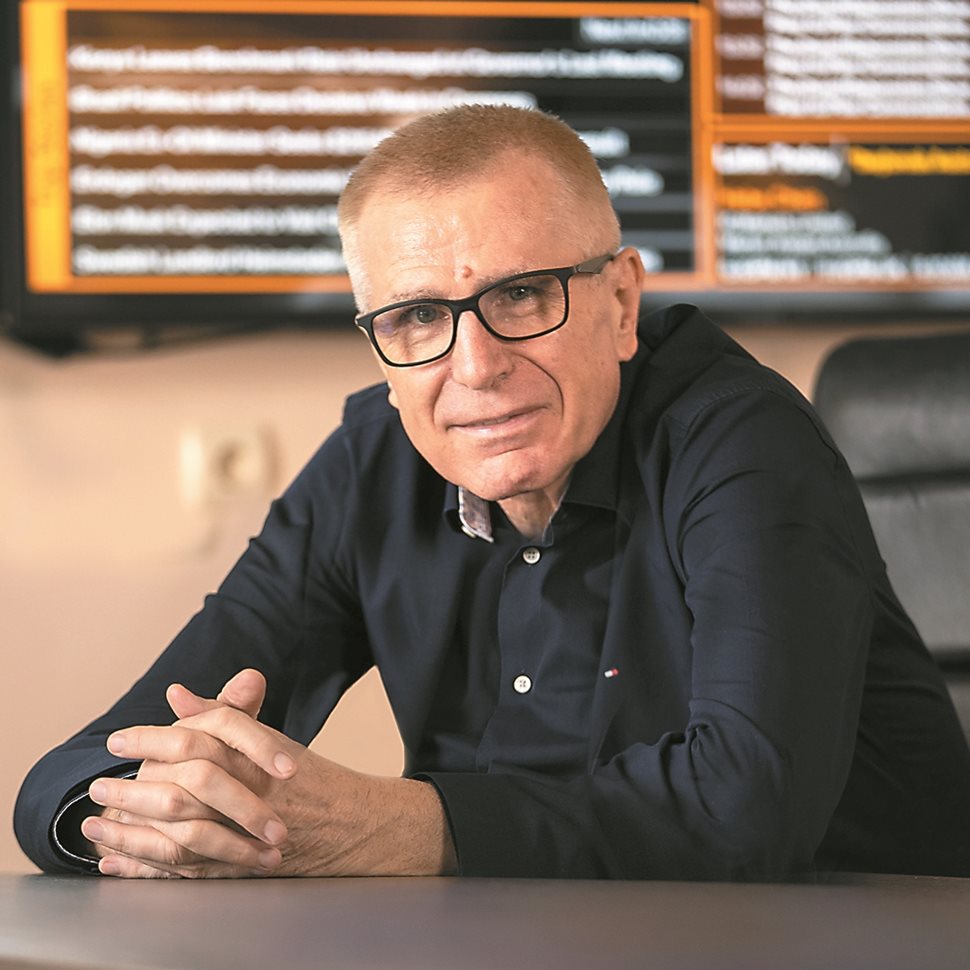
Hristo Kovachki, Businessman and entrepreneur
I don’t like working with people who set low goals for themselves
The lessons learned from mistakes are harsher, but far more important, they set the wheels of success in motion
Hristo Kovachki holds a doctorate in technical sciences. He is the author of inventions in the fields of lasers, electronics, and energy, has developed various technologies, and holds over 15 patents in the areas of ecology and energy. He is fluent in English, French, and Russian. In 2013, he published the book “Universal Order – Theory of Knowledge”. His diverse business interests focus on introducing innovations into Bulgaria’s energy sector. He is married and has two children.
This interview is part of the special edition by “24 Chasa” and TREND, titled “Men: A Leading Role”, part of the series spotlighting accomplished individuals with visionary insight. The latest issue is dedicated to men who make important and difficult decisions every day – leaders who are shaping the future of business, technology, values, and the aspirations of modern society. “Men: A Leading Role” is a publication for the curious and the bold – for those with a natural instinct for change and the strength to carry the weight of growth.
– Who played the first leading role in your life?
– My mother and father. Every memory with them is incredibly vivid.
– Were you influenced by the adults around you as a child, or were you more independent-minded?
– I didn’t see myself as an individualist, nor was I invisible. I had my own opinions and loved to read. Math was my favourite subject because it’s based on logic. I enjoyed it when my teachers challenged me with harder problems. I wouldn’t say there was anyone more influential in my upbringing than my parents.
– Do you remember your first important decisions or personal battles as a child?
– Probably the toughest battles were the ones I fought with myself. Choosing between studying architecture or physics was one of those. Science has always felt closer to my inner world, and now I see that choice as the right one.
– What was your childhood like, and how is it different from that of today’s children
– I spent a lot of time at the library. There was no gateway to knowledge like the internet is today. We had much more face-to-face interaction. We rode bikes, skied in the winter, played football. Every era has its advantages. Today, you can access knowledge without limits, you can travel almost anywhere, and children dream bigger – and those dreams aren’t out of reach. But just as opportunities have grown, so have risks.
– Have you ever wanted to live somewhere else?
– When I graduated, I was offered a research position at an American institute. But my family was the main force that pulled me back to Bulgaria.
– What are the most important steps in a man’s life on the path to success?
– I measure my success by the success of my children. Their birth was the most important milestone. I am blessed with a wonderful family, and that’s my superpower. Everything else comes second.
– When and how was the seed of success planted in you?
– I’d be lying if I said I wasn’t proud when I graduated from the high school of mathematics with honors. Every age has its own challenges and successes. As the years went by, I realized that I feel much more fulfilled when I help young, knowledgeable, and ambitious people realize their potential and grow.
– How has luck affected the course of your life so far?
– I’ll quote Henry Ford: “Luck is what happens when preparation meets opportunity”.
– Has success or failure taught you the most along the way?
– The lessons learned from mistakes are harsher, but far more important, they set the wheels of success in motion.
– If your life so far were a movie, what genre would it be, and what would the title be?
– “Theory of Knowledge”. That’s the title of my book, because knowledge is the key to evaluation. I like to believe that my movie would have a plot similar to “Forrest Gump”. Tom Hanks delivers an incredible performance where the main characters become the driving force and willpower. They break the chains, and in doing so, a child with a serious illness leaves a lasting impact on society.
– What will set your company and your business apart in 2024?
– Innovation, flexibility, diversification, and a well-prepared team. This is how I approach every project. I hope that 2024 will bring a better and more stable business climate, as the past years have been filled with crises. I want to believe that what will set us apart is the ability to execute projects faster and with even greater added value.
– Which business decisions are you most proud of?
– For all these years, we’ve managed to protect and preserve the jobs and dignity of tens of thousands of Bulgarians. I’m truly proud of the people I’ve managed to bring into my team.
– What compromises are you willing to make in business, and which ones will you never tolerate?
– I don’t like compromises, but they are unavoidable. I can’t tolerate lies, nor can I work with people who set low goals for themselves.
– What are the trends in your industry – those you create and the global ones you follow?
– The ones based on science and innovation, those that are constructive and creative. Only this way can sustainability be guaranteed. I don’t like blindly following trends because that means falling behind, waiting. There’s a theory I believe in: it’s not the big that eat the small, it’s the fast that eat the slow.
– What innovations are you making in your business to always stay one step ahead?
– I enjoy working with people from whom I can learn and build upon what we’ve already achieved. Recently, I had a meeting with Neil Bush and global technology leaders, where we discussed opportunities to reduce carbon dioxide emissions from conventional power plants. Their team has developed a technology that does this by using ammonium carbonate, and the by-product generated is a fertilizer suitable for agricultural use. This is an intriguing project for me, and I hope we can implement it at a Bulgarian power plant. I enjoy being involved in the implementation of innovations with high added value. Neil Bush is the founder and chairman of a foundation named after his father – the former American President George Herbert Walker Bush, and he partners with Chinese tech giants in the areas of philanthropy and innovation. This meeting was one of the most impressive ones I’ve had recently.
– How do you recognize that an idea or project will bring success?
– It’s not enough for an idea to be based on the latest trends. It’s very important that I can envision it developing over the next 5 and 50 years.
– Is there such thing as a “male” and “female” business? As a man, what makes it easier for you in the field you are in, and what would be the advantages for a woman?
– In modern times, there are no boundaries. Still, I would like to believe that more physical professions will remain a privilege for men, as women should be somewhat more protected. That being said, women are excellent managers and experts in all fields.
– What does success in Bulgaria look like? Houses, cars, and prestige, or more like influence, a visionary approach, the opportunity to implement ideas and ideals?
– Success in Bulgaria should be like anywhere else in the world. For me, the indicators are different from those you’ve listed – how sustainable is the business you manage, what is its added value, and what is your contribution to society or at least to the future of the people you are in charge of.
– What’s the most recent thing your children have done to surprise you? Do you learn from them?
– They surprise me every day. There are many things I learn from them. Only they can say what kind of parent I am, but I hope I am one who challenges them to fulfill their dreams and be good people. Their successes make me happy. My son still makes me proud with his progress in school, and my daughter is already thriving in her career, even though she graduated only recently.
– Do you have a vision for the industry you are in for the next 10-20 years?
– I think that would mean we have a short-term vision. I hope that the European Union’s vision for full decarbonization by 2050 comes true. My team and I are guided by this goal, working to gradually reduce carbon dioxide emissions in Bulgarian energy. I hope young Bulgarian engineers successfully complete this process.
– Is the rise of artificial intelligence in our lives a threat or an opportunity?
– The leading role will always belong to humanity. Artificial intelligence is an opportunity for us to be more flexible and to optimize some of the processes in our lives.
– Do idealists have a place in business? Is it harder for them to break through, or the opposite?
– Einstein was seen as a dreamer before he discovered the Theory of Relativity. Without dreams and a dose of idealism, we would be robots.
– Nowadays everyone talks about and tries to build on the green idea – how do you see it?
– I view the green idea as a dream for a cleaner environment and a better way of life, which is tied to changing how we think about the world around us. I believe it will evolve gradually.
– What should leaders be like in 2024, and what will they be like in 2044, in politics and business?
– On the one hand, they should be educated, thoughtful, responsible, even dreamers; on the other hand, they must have practical experience in the field they work in. But there is also a third aspect – preserving family and human values. I hope this third aspect remains just as important.
Source: 24 chasa