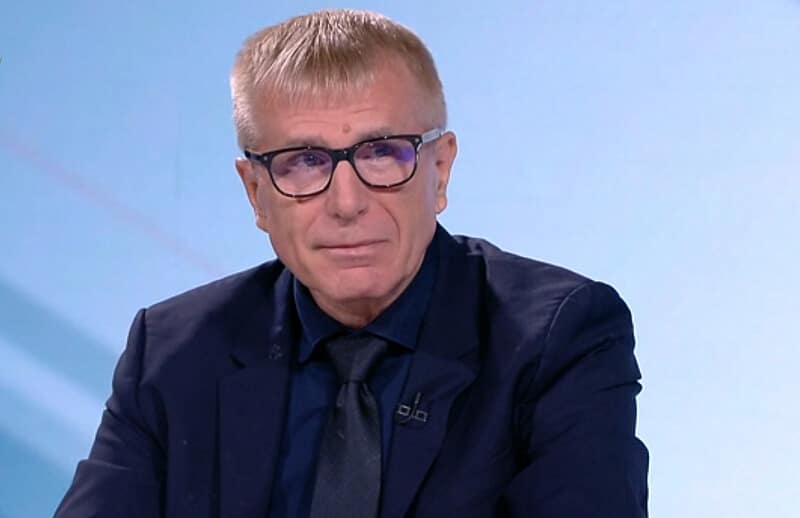
Businessman, scientist, inventor, and now also a published author.
You may have read all sorts of things about Hristo Kovachki, but this interview will focus solely on his insights and the conclusions he has drawn over the years. The occasion for this interview is the release of his first book “Universal Order – Theory of Knowledge”.
Hristo Kovachki holds a degree in physics and a doctorate in technical sciences. He graduated quantum electronics from LITMO (Leningrad Institute of Precision Mechanics and Optics) in St. Petersburg. Rumor has it that he is among the wealthiest Bulgarians, and plenty of films and media stories have featured his name. But that’s not our interest here. We are interested in why he picked up the pen and what he has to say.
Mr. Kovachki, in your book you write that the ultimate goal of evolution is the generation of knowledge. Is that the meaning of life? Why shouldn’t the meaning of life be drugs, alcohol and promiscuity?
I spent a long time asking myself what the meaning of human life is, and I came to the conclusion that it lies in the generation of knowledge. If you think about it, knowledge is what gets passed down from generation to generation, multiplying with each passing year. But accumulating knowledge cannot be an end in itself. For it to have meaning, it must be applied in constructive processes – ones that benefit society. The more we stimulate the development of knowledge, the more societal output grows. Of course, as you know, some people can achieve more than others. The Theory of Knowledge outlines a set of principles that we should follow on the path to knowledge in order to reach our full potential.
-In the Old Testament, Ecclesiastes tells us: “For with much wisdom comes much sorrow; the more knowledge, the more grief.” What is your view on these words, and would you describe yourself as a believer?
Yes, I am a believer. It’s no coincidence that the Bible is often called the greatest book ever written—it has preserved a vast amount of wisdom. In fact, knowledge comes with responsibility. Just look at society. Compare someone who never went to school with a manager of a company. The first has basic needs—food, shelter, and that’s about it. The second has already met those needs but bears responsibility for many others: keeping the business running, making it more competitive, expanding its market share, and providing growth opportunities for their team. So, you see, greater needs are linked to much greater effort—and they come with a heavy burden of responsibility.
Your book is entitled “Universal Order”. If the universe is perfect and in order, why is our civilization not? There are wars, conflicts, some people live in extreme poverty, while others are extremely wealthy.
Wars and orders are part of the order. In fact, chaos is the opposite of ideal order and anything that deviates from that ideal is a mix of both chaos and order. When a society is progressing — that is, when it generates more knowledge than it consumes – its processes are constructive. But in the opposite case, when a society is in decline, change becomes necessary. This is the basic explanation for negative phenomena like wars or conflicts: they serve as a form of self-regulation aiming to restore balance. The book includes many historical examples of how societies evolve.
As for why some people are poor while others are rich – the answer is similar: those who participate more actively in the process of acquiring knowledge tend to create more, and in turn, receive more.
You are a successful modern man. Why did you take up writing? Surely it wasn’t for profit – you already have other ventures that generate income.
I felt the need to share the knowledge and experience I’ve accumulated.
We have to ask you this: do you have the ambition to continue writing? What do you dream of writing next?
Actually, my dream is to establish an institute for scientific research with practical applications. A team is already in place—though still small—and I can say I’m proud of what we’ve accomplished in the short time we’ve been working together. As for writing, it came to me as a natural process.
Is it difficult to succeed with a private business in Bulgaria – and is it just as difficult to succeed as a writer?
Writing was harder for me than business, but it gave me a lot of energy. In the book, I say that one of the key principles for maintaining order is constructiveness. In that sense, I try to build—not destroy—in my business as well. Yes, it’s difficult, but with persistence and faith in what I do, things work out. You know, there’s a quote by Steve Jobs that perfectly captures what I think: “If you have twenty bricks, you can lay them on the ground—and you’ll have twenty bricks on the ground. Or you can stack them to start building a wall.” If people find value in what I’ve written, then I’ll consider that a success too. Time will tell.
We wish you success in all your endeavors. What can readers expect to learn from your book “Universal Order – Theory of Knowledge”?
The Theory of Knowledge is not just words on paper. I’ve made an effort to ensure that it’s applicable in our daily lives. That’s why the book includes a Personal Guide and a Self-Study Manual for the modern manager. Try following the guidance outlined there and see what kind of change the Theory of Knowledge can bring to your life. Ultimately, this is my personal philosophy, and I hope it can be of help to you too.
Source: brato.bg